
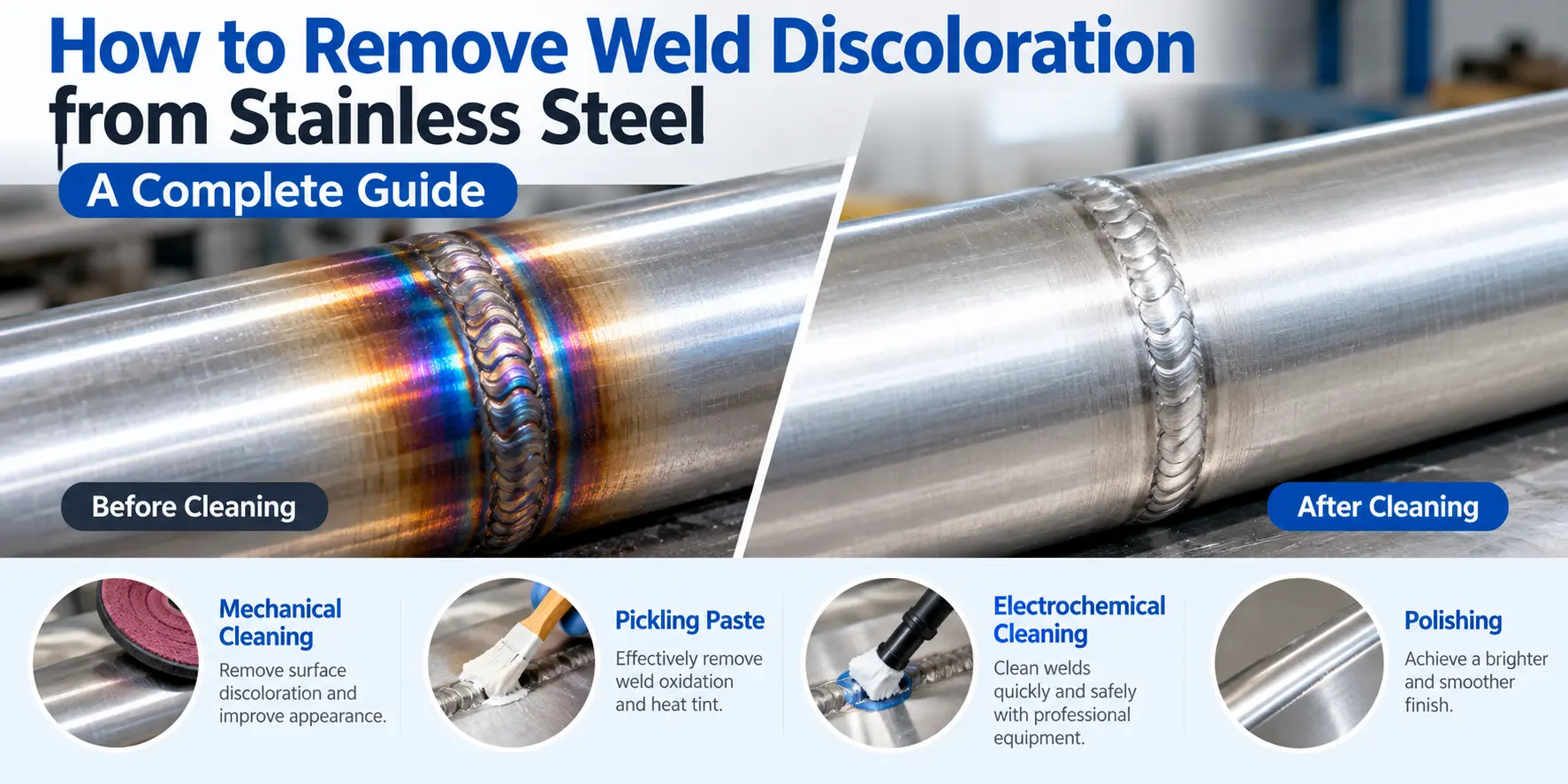
Welding stainless steel often leaves behind blue, purple, yellow, brown, or black discoloration around the weld. These marks, commonly called heat tint, can affect the appearance of the finished product and may reduce corrosion resistance in the affected area.
Whether you work with stainless steel railings, kitchen equipment, tanks, pipes, or fabricated components, choosing the right cleaning method is important for achieving a clean, consistent finish.
In this guide, we explain why weld discoloration occurs, compare common cleaning methods, and help you choose a suitable approach for your project.
Why Does Stainless Steel Discolor After Welding?
Stainless steel contains chromium, which helps form a protective oxide layer on its surface. During welding, high temperatures cause additional oxidation, creating visible colors around the weld.
The appearance and severity of heat tint depend on factors such as welding temperature, shielding gas coverage, surface condition, and exposure to oxygen.
Although some discoloration may appear cosmetic, heavy heat tint can indicate surface changes that require appropriate post-weld treatment, especially where corrosion resistance matters.
4 Common Methods for Removing Weld Discoloration
1. Mechanical Cleaning and Polishing
Mechanical cleaning uses abrasives, polishing wheels, or other suitable tools to remove surface discoloration.
Advantages:
- Useful for surface finishing and appearance improvement.
- Can be effective on accessible weld areas.
- Does not require chemical pickling products.
Limitations:
- May leave scratches or change the surface texture.
- Can be time-consuming on complex welds.
- Improper tools may introduce contamination.
Use abrasives and tools intended for stainless steel to avoid introducing carbon-steel contamination.
2. Stainless Steel Pickling Paste
Pickling paste is a chemical treatment used to remove certain surface oxides and heat tint from stainless steel.
It is commonly used for localized treatment of welds where an appropriate chemical pickling process is specified.
Advantages:
- Can treat areas that are difficult to reach mechanically.
- May be suitable for localized weld treatment.
- Can help remove oxide layers associated with welding.
Limitations:
- Some formulations contain highly hazardous acids.
- Application, exposure time, rinsing, and waste disposal require strict control.
- Not every product is suitable for every stainless steel grade or application.
Always follow the product’s Safety Data Sheet (SDS), technical instructions, and applicable workplace safety requirements. Never mix cleaning chemicals.
3. Electrochemical Weld Cleaning
Electrochemical weld cleaning uses suitable equipment, electrodes or brushes, and compatible cleaning solutions to treat discoloration around stainless steel welds.
Advantages:
- Can be useful for localized weld cleaning.
- May offer controlled treatment of accessible weld areas.
- Certain systems also support finishing or marking applications.
Limitations:
- Requires compatible equipment and consumables.
- Results depend on the machine, solution, stainless steel grade, and operating settings.
- Incorrect use can damage the finish or produce inconsistent results.
4. Surface Polishing for a Brighter Finish
After weld cleaning, some projects require additional polishing to improve surface appearance.
For decorative stainless steel components, a smoother or more reflective finish may be desirable. However, removing heat tint and achieving a mirror-like finish are not necessarily the same process.
The required polishing method depends on the starting surface, weld condition, and desired appearance.
Which Weld Cleaning Method Should You Choose?
| Your requirement | Method to consider |
|---|---|
| Remove surface marks and improve appearance | Mechanical cleaning or suitable weld cleaning treatment |
| Treat localized weld oxidation | Compatible pickling or electrochemical cleaning |
| Work around complex weld shapes | A method designed for the geometry and material |
| Achieve a brighter decorative finish | Cleaning followed by appropriate polishing |
| Maintain corrosion resistance in demanding service | A validated post-weld surface treatment process |
The best method depends on the stainless steel grade, severity of discoloration, surface finish, operating environment, and applicable specifications.
How to Choose a Weld Cleaning Product
Before purchasing a weld cleaning solution or machine, consider these questions:
- What stainless steel grade are you working with?
- Are you removing heat tint, improving gloss, or both?
- Is the workpiece small, large, flat, or difficult to access?
- Do you already have compatible electrochemical cleaning equipment?
- What cleaning, rinsing, safety, and waste-handling procedures are required?
For product options, explore our Weld Cleaning Solutions and Weld Cleaning Machines.
Frequently Asked Questions
Can weld discoloration affect stainless steel corrosion resistance?
Yes. Heat tint can be associated with changes to the surface oxide layer and localized chromium depletion, which may reduce corrosion resistance. The significance depends on the material and service conditions.
Can all stainless steel welds be cleaned with pickling paste?
No. Product compatibility, stainless steel grade, finish requirements, and safety conditions must be checked before treatment.
Is electrochemical weld cleaning better than mechanical polishing?
Neither method is universally better. Electrochemical cleaning may be useful for certain weld cleaning tasks, while mechanical polishing may be more appropriate for specific surface finishing requirements.
Does removing weld discoloration automatically create a mirror finish?
No. A mirror finish generally requires a suitable surface preparation and polishing process beyond simply removing visible heat tint.
Final Thoughts
Removing weld discoloration from stainless steel requires more than choosing the strongest cleaner. The right process should consider the material, desired finish, corrosion resistance, safety, and overall production requirements.
At LP Weld Solutions, we offer weld cleaning solutions, polishing products, and equipment for different stainless steel surface treatment needs.
Explore our product range or contact us to discuss which solution may suit your application.